

How to Organize Pots and Pans: Stress-Free Kitchen Storage Tips

So, let me guess—you open your kitchen cabinet and it’s a chaotic jungle of mismatched lids, stacked skillets, and a saucepan avalanche waiting to happen.
If this sounds familiar, you’re not alone.
Many of us love cooking, but when it comes to storage, the struggle is real.
That’s where knowing how to organize pots and pans comes in.
With a few smart tricks, you can transform your cluttered cabinets into a functional, accessible, and even visually pleasing space.
Why Organizing Pots and Pans Matters
At first glance, you might think, “Why bother?” But trust me—getting your pots and pans in order is more than just a visual upgrade.
Here’s why:
- Efficiency: You’ll spend less time digging through piles and more time actually cooking.
- Longevity: Proper storage prevents scratches, warping, and premature wear on your cookware.
- Safety: Stacked and unstable cookware can be a tipping hazard.
- Peace of mind: A tidy kitchen just feels better. You can actually enjoy cooking instead of fighting your cabinets.
So yeah, organization isn’t just about aesthetics—it’s about making your cooking life easier.
Assess Your Current Collection
Before you start rearranging, it helps to take stock. Ask yourself:
- Which pots and pans do I use most often?
- Are there duplicates or rarely used items taking up space?
- Do I have all the lids for my cookware?
Tip: If a pan hasn’t been used in the past year, it might be time to donate or sell it. Less clutter = easier organization.
Storage Strategies for Pots and Pans
There’s no one-size-fits-all solution, but several strategies consistently work. Here’s how to organize pots and pans like a pro:
1. Stack with Care
Stacking is the most common method—but it can get messy fast. To stack efficiently:
- Sort by size: Large skillets at the bottom, smaller ones on top.
- Use protective layers: Felt pan protectors or even dish towels prevent scratches on nonstick and stainless steel surfaces.
- Nest only compatible items: Avoid stacking heavy cast iron with lightweight pans; it can damage the smaller ones.
Pro tip: Always keep the most-used pan on top for easy access.
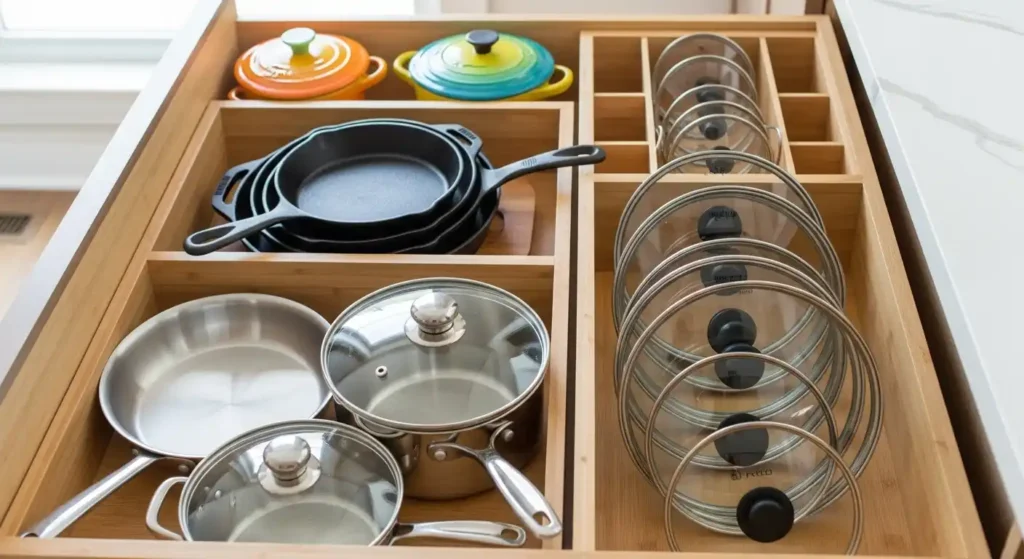
2. Use Vertical Dividers
Vertical storage is a game-changer, especially for deep cabinets. Here’s how to make it work:
- Install vertical dividers to store skillets, baking sheets, and lids upright.
- This reduces stacking and makes each item easy to grab.
- Bonus: It prevents scratching and keeps your nonstick surfaces intact.
Think of it like a record collection—easy to see and even easier to pull out.
3. Lid Organization
Lids are often the worst part of pot and pan chaos. A few solutions:
- Cabinet lid racks: Adjustable racks let you store lids vertically.
- Hanging lid organizers: Mount inside cabinet doors to free up space.
- Drawer storage: If you have a deep drawer, dedicate it to lids sorted by size.
Keeping lids organized makes cooking smoother—you won’t be chasing a lid that “disappeared” three weeks ago.
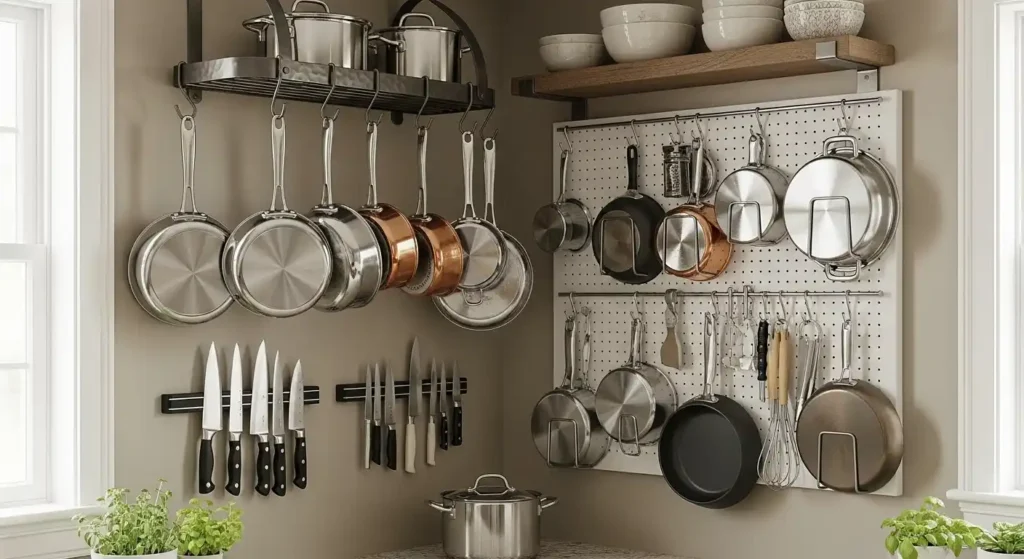
4. Hanging Solutions
If cabinet space is tight, think vertically. Hanging pots and pans is both functional and stylish.
- Pot racks: Ceiling or wall-mounted racks keep cookware within easy reach.
- Hooks: S-hooks or pegboards allow pans to hang neatly.
- Magnetic bars: Great for smaller pots, utensils, or lightweight pans.
Hanging pans not only looks professional, it also keeps heavy skillets from getting squashed in cabinets.
5. Pull-Out Shelves and Drawers
If you’re remodeling or investing in kitchen storage solutions, pull-out shelves are amazing:
- Store pans and lids in drawers instead of deep cabinets.
- Pull the drawer out, grab what you need, and push it back—no more digging or stacking disasters.
- Adjustable dividers make it easy to separate different sizes and types.
Even in older kitchens, some DIY pull-out solutions can be installed to dramatically improve accessibility.
6. Use Multi-Functional Storage
Some items can pull double duty. For example:
- Baking sheet dividers can hold cutting boards, cookie sheets, and even large lids.
- Lazy Susans in corner cabinets allow you to spin and grab your pots without moving anything.
The key is to maximize space without creating unnecessary clutter.
Declutter First
Before you reorganize, declutter ruthlessly:
- Donate or sell duplicate pans.
- Toss warped, cracked, or rusted items.
- Match lids to their pans and store mismatched ones separately.
You’d be surprised how much space a few minutes of decluttering can free up. Less clutter makes organization much easier and sustainable.
Maintenance Tips
Once you’ve mastered how to organize pots and pans, keep it that way with some simple habits:
- Return items to their spot immediately after washing.
- Clean pans properly to avoid residue or rust—this also helps them fit neatly in your storage.
- Re-evaluate every 6–12 months to remove items you rarely use.
Consistency is key—organized cabinets only stay that way if you maintain them.
Material-Specific Storage Considerations
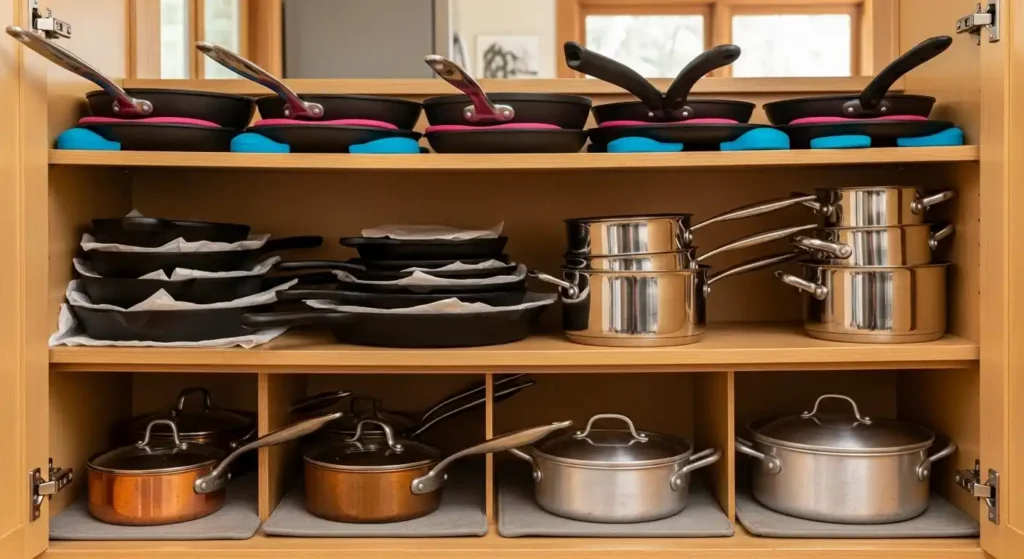
Different cookware materials require different handling:
- Nonstick pans: Avoid stacking with metal pans or other heavy items; use protective pads.
- Cast iron: Can be stacked but make sure they’re dry to prevent rust; consider a paper towel layer between each.
- Stainless steel: Generally durable; stack carefully to avoid scratches.
- Copper/aluminum: More delicate; keep separated to maintain the finish.
Understanding the material helps prevent damage and extends the life of your cookware.
Common Mistakes to Avoid
Even with the best intentions, mistakes happen. Avoid these pitfalls:
- Overstuffing cabinets: Trying to fit too many pans will cause scratches, warping, and frustration.
- Ignoring lids: Losing lids makes it harder to cook efficiently.
- Stacking incompatible materials: Nonstick under cast iron? Not ideal.
- Not labeling or grouping: If items aren’t grouped logically, it becomes harder to find what you need.
A little thought before you start saves you a lot of headaches later.
Final Thoughts
Knowing how to organize pots and pans isn’t just about aesthetics; it’s about functionality, safety, and saving time in the kitchen.
Start with the essentials, declutter ruthlessly, and use storage solutions that suit your kitchen layout and cooking style.
Whether it’s vertical racks, pull-out drawers, hanging pot organizers, or simple stack-and-sort techniques, the key is to make every pan accessible, protected, and easy to use.
Your cabinets don’t need to look like a cookware store display—they just need to be functional.
Once you implement these strategies, you’ll wonder how you ever cooked in that chaotic mess before.
Organized cookware makes cooking more enjoyable, more efficient, and honestly, a little less stressful.


